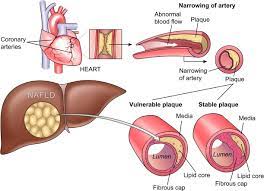
18 viewsFatty liver is a condition in which there is fatty deposits in the liver (liver steatosis) in people where high alcohol consumption is not the probable cause. Fatty liver is usually associated with alcohol abuse. When a tissue sample is taken from a liver with an increased fat content, it is not possible to distinguish fatty liver caused by alcohol use from fatty liver that is not caused by alcohol. Non-alcoholic fatty liver disease the most common chronic liver disease. The incidence increases with overweight or obesity, and with high cholesterol and type 2 diabetes. Fatty liver increases the risk of cardiovascular disease more than fatty liver increases the risk of severe liver disease.
There is a clear link between fatty liver disease and general obesity. One hypothesis is that the body’s sensitivity to insulin decreases, which in turn leads to increased blood sugar and increased fat production both in the liver and in the body in general.
Decreased insulin sensitivity can lead to type 2 diabetes and increased levels of fats in the blood. Too fast dieting / weight loss can also lead to this type of fatty liver. Among other things, there is an over-frequency after obesity operations. Research has shown an association between fatty liver and the development of arteriosclerosis (atherosclerosis and cholesterol deposits) in the carotid arteries and in the coronary arteries (the coronary arteries around the heart). There is a connection between fatty liver and the development of heart fibrillation, stroke, heart attack and dementia. Many people with hepatic steatosis also have high blood pressure and diabetes in addition to the fact that most are overweight. The association between hepatic steatosis and arteriosclerosis appears to persist even if one adjusts for the known risk factors for cardiovascular disease. This means that there are more patients with fatty liver who develop cardiovascular disease than there are patients with fatty liver who develop severe liver disease.
Today, with newer methods, an even more accurate risk assessment can be obtained. As we now know, fatty liver increases the risk of heart disease and stroke. The doctor should map the overall risk (gender, age, smoking history, heredity, blood pressure, cholesterol levels and diabetes) for the development of cardiovascular disease. Together with these traditional risk factors, an even more accurate assessment will be obtained when examining the carotid arteries, groin arteries with ultrasound for the detection of atherosclerosis and cholesterol deposits. Low risk of developing severe liver disease In most people with non-alcoholic fatty liver, an increased amount of fat is detected in the liver, without signs of other disease or impaired liver function. Hos ca. 5%, the accumulation of fat leads to a persistent liver inflammation, and irreversible liver changes such as cirrhosis can develop. This is more common in patients with alcohol-induced fatty liver. Fatty liver that has not led to inflammation or failing liver function, usually gives no symptoms. The condition is often discovered by chance with an elevated blood test called ALT. In some people, fatty liver can lead to malaise and weakness, and some people are bothered by discomfort and heaviness in the liver area – that is, under the right costal arch (rib arch). During a regular medical examination, palpation can sometimes show that the liver is slightly enlarged. The condition is associated with a slightly increased risk of cardiovascular disease, and premature death. Women and fatty liver. Research from the USA showed that fatty liver is especially unfortunate for women with regard to the development of arteriosclerosis, cardiovascular disease. Women are less likely to have a heart attack than men, and if a woman first has a heart attack, this usually happens later than in men. The research showed that women who have fatty liver have a significantly higher risk of cardiovascular disease than both men and women who have a nice liver, and approx. as high as in men with fatty liver! A 50-year-old woman with a fatty liver has as high a risk of heart disease as a man of the same age with a fatty liver. This woman also has as high a risk of heart disease as a woman 17 years older (67 years) and a man of 58 years, who does not have a fatty liver.
Also Read – bit.ly/windowstxt 10
The conclusion is that the protective factor of being a woman seems to disappear with proven fatty liver.
Treatment of fatty liver. The only treatment we know helps is weight reduction. A controlled weight reduction causes the fat deposition in the liver to stop and return. It has also been shown that inflammatory changes improve or disappear completely with dieting. A weight reduction of approximately 5-10% of body weight has been shown to be able to stop the development of the disease. To make a closer diagnosis, an ultrasound examination is relevant, where you can clearly see that the liver has increased echogenicity (brighter on the ultrasound screen). It is common to recommend a check-up with a doctor to follow the development. Check Health focuses on preventive health and medical specialists in radiology will perform an ultrasound assessment of the arteries with ultrasound to map the cardiovascular risk
 HSS Live News